Most naturalization delays do not start at the office. They start in the application: a missing translation, an expired registration certificate, a CV with a gap. This checklist shows which documents German naturalization offices require in 2026, which ones need a translation or apostille, and the order in which to collect them.
In short
- 13 document groups; usually 3 to 5 of them need a certified translation.
- Only translators sworn in Germany are accepted. Anything else risks a follow-up request.
- Fee 255 € per adult; side costs typically 150 to 450 €.
- Order: obtain and apostille documents at home first, then translate, then apply.
The checklist: every document at a glance
Each naturalization office sets its own list. The table below contains the documents that the information sheets of the large cities consistently require. Check your own office’s sheet as well; most publish it online.
| Document | Who | Translation | Note |
|---|---|---|---|
| Naturalization application form (paper form or the office’s online portal) | Everyone | No | Fill in every field. Each gap triggers a follow-up request. |
| Valid passport and current residence permit | Everyone | No | Copy all used pages; bring originals to the appointment. |
| Birth certificate | Everyone | Yes, if not in German | Depending on the country, an apostille or legalisation is also required. |
| Marriage certificate, divorce decree, spouse’s death certificate | Married, divorced, widowed | Yes, if not in German | Court decrees run several pages; translation is priced per page. |
| Children’s birth certificates, proof of custody | Parents | Yes, if not in German | Mandatory when children are naturalised with you. |
| B1 German certificate (telc, Goethe, DTZ, ÖSD) or a German school or vocational qualification | Everyone | No | Bring the original. Foreign school certificates do need translation. |
| Naturalization test or “Leben in Deutschland” certificate | Everyone without a German school qualification | No | The test costs 25 € and is taken at an adult education centre (VHS). |
| Proof of income: employment contract, last 3 to 6 payslips, pension insurance record | Everyone | No | Self-employed: tax assessments and profit statement. |
| Registration certificate (Meldebescheinigung), rental contract or proof of ownership | Everyone | No | Registration certificate usually no older than 3 to 6 months; offices differ. |
| Proof of health insurance | Everyone | No | Current confirmation from your insurer. |
| Gap-free CV in table form | Everyone | No | Residence, education and work with no unexplained gaps. |
| School, vocational and university certificates | On request | Yes, if not in German | Foreign degrees may need formal recognition. |
| Biometric passport photo | Everyone | No | No older than 6 months. |
Certified translation: what the office accepts
Foreign-language documents must be translated by a translator who is court-sworn, authorised or publicly appointed in Germany. The translation carries a stamp, a signature and a statement of accuracy and completeness. Many offices reject translations made abroad, even when notarised there. Submitting one anyway costs weeks until the follow-up request arrives.
Prices depend on page count and language. A one-page birth certificate costs far less than a multi-page divorce decree. Compare fixed prices before ordering: online providers show the price per document upfront, while local agencies often bill per line.
Apostille or legalisation: settle this before translating
The office wants proof that a foreign document is genuine. There are two routes. For countries in the Hague Convention, an apostille from the issuing authority confirms authenticity. For all others, the German embassy or consulate must legalise the document. Both must happen before translation, because the translator also translates the apostille text.
Common mistake
Costs in 2026: fee and side costs
The statutory fee under § 38 StAG is 255 € per adult and 51 € per child naturalised alongside a parent. It is due only when the decision is issued. The side costs come earlier and are often underestimated: the language certificate (telc B1 roughly 155 to 240 € depending on the centre, Goethe B1 roughly 200 to 270 €), the naturalization test at 25 €, translations, apostilles and obtaining documents from abroad. Application services quote 150 to 450 € as a typical range.
The right order
- Read your own office’s information sheet. Note where it differs from the table above, such as the maximum age of the registration certificate or extra forms.
- Obtain and apostille documents from your home country. This takes longest and depends on third parties. Start immediately.
- Secure the language certificate and the naturalization test. Exam dates in large cities are often booked out weeks ahead.
- Order translations once the apostilled originals are in hand. Order all documents together to save shipping and processing time.
- Pull German documents last: registration certificate, payslips and health insurance confirmation should be as recent as possible.
- Submit and document the receipt date. That date starts the processing clock. Enter it in the Citizify naturalization timeline and compare your case with other applications in your city.
Frequently asked questions
Which documents need a certified translation?
Every document that is not in German: typically the birth certificate, marriage certificate, divorce decree, children’s birth certificates and foreign school or university certificates. The office requires a translation by a translator sworn or authorised in Germany. Translations made in your home country are frequently rejected.
Do I need an apostille or legalisation?
It depends on the issuing country. For states party to the Hague Apostille Convention, an apostille from the issuing authority is enough. For other states, the German embassy or consulate must legalise the document. Ask your naturalization office before ordering translations whether it requires this and for which documents.
How much does German naturalization cost in total?
The statutory fee is 255 € per adult and 51 € per child naturalised with a parent. On top come the language certificate, the naturalization test, translations, apostilles and obtaining documents from abroad. Application services quote 150 to 450 € as a typical range, depending on the country of origin and the state of your paperwork.
How long does naturalization take after submitting the documents?
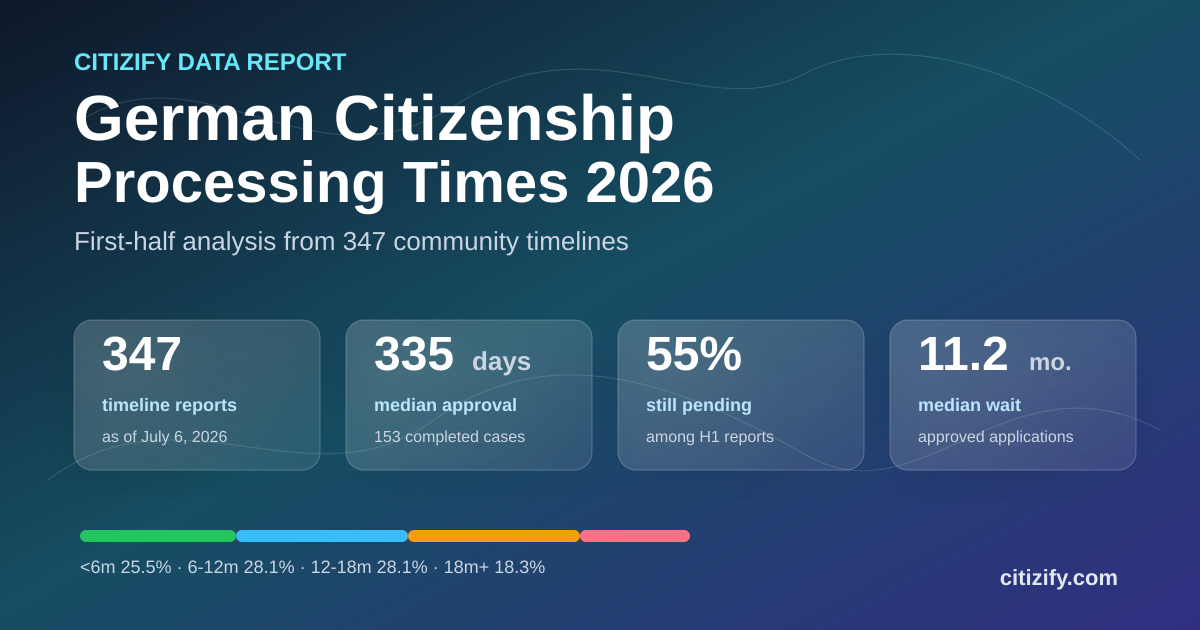
It varies widely by city. In the Citizify timeline, users report an average of roughly 250 days for Berlin and more than 500 days for Munich. A complete file shortens the process, because every follow-up request sends your case back into the queue.
This article is not legal advice. Your naturalization office’s information sheet is authoritative. Links to translation providers are partner links; the price you pay does not change.
Did this guide help you?
☕ Support Citizify
We create free resources for language learners. Your small contribution helps us keep going.
Thank you for your support! 💙