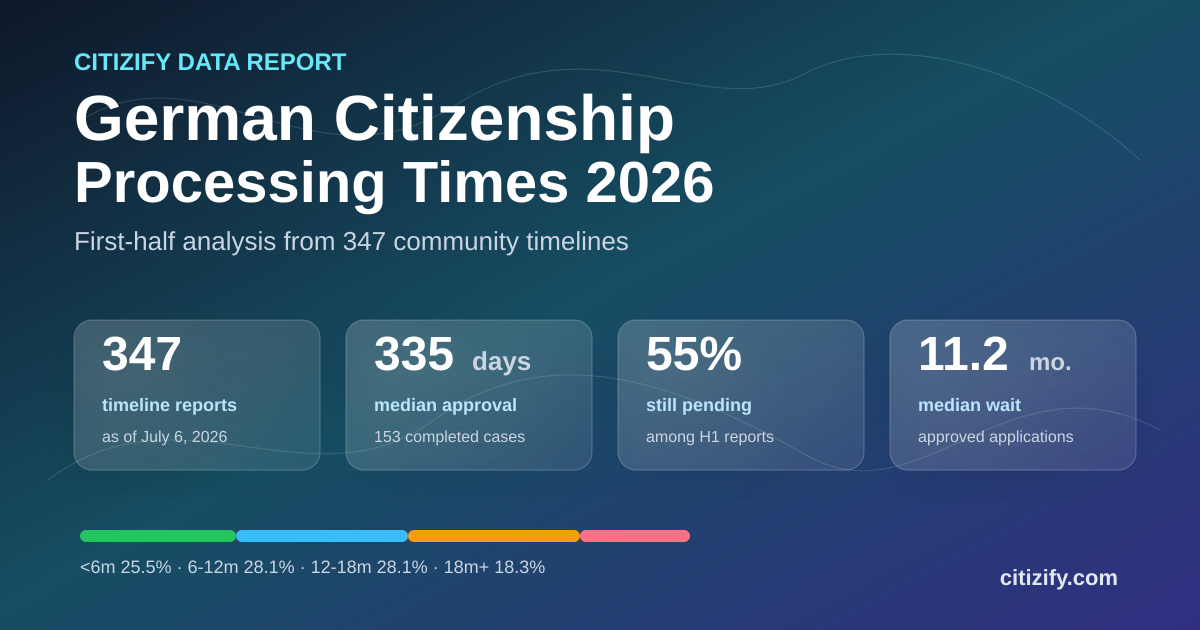
With the new citizenship law taking effect in Germany, application processes, waiting times, and eligibility requirements have changed significantly. The standardization of dual citizenship and the shortened residence requirement offer new opportunities for hundreds of thousands of people. However, the increased volume of applications requires managing the process more strategically than ever. Proper preparation, submitting a complete file, and understanding how local authorities operate are critical to minimizing a wait that can otherwise take months.
Source note: This article is informational only. Rules and administrative practice can change. Always verify time-sensitive or legal details with official German authorities or a qualified immigration professional.
💡 Before applying, ensure all your documents (especially the B1 language certificate and Einbürgerungstest result) are complete and up to date. Applying with missing documents is the most common reason waiting times are extended by months or years.
At a Glance
Current Application Requirements and Dual Citizenship
With the reforms made to the citizenship law in Germany, dual citizenship (Mehrstaatigkeit) has become a general right. Immigrants can become German citizens (Einbürgerung) without having to give up the passport of their home country. To apply, the most basic requirements are a verified identity, no criminal record, a declared commitment to the free democratic basic order, and the ability to support oneself and dependent family members without receiving social assistance.
The new regulations have redefined the required legal residence periods. The standard time for naturalization is now set at 5 years. It is a fundamental requirement that applicants have completed this 5-year continuous legal residence. The type of residence permit held is highly important when calculating the residence period, and temporary visas are generally not fully included in this timeframe.
The most significant risk factor for eligible applicants is processing times. Due to the high demand brought by the new law and the current workload of local immigration offices (Ausländerbehörde or Einbürgerungsbehörde), finalizing citizenship procedures can take months or even years, depending on the city where you apply. The only way to minimize these long waiting periods is to submit a complete file containing all income documents, official language certificates, and citizenship test results at the time of application.
Financial Self-Sufficiency and Calculating Residence Periods
When calculating the residence period, not every year spent in Germany is evaluated under the same status. For example, whether time spent on a student visa (residence for study purposes) fully counts toward a citizenship application can vary based on the discretion of the individual states. Time spent with an EU Blue Card (Blaue Karte) or a skilled worker visa is directly taken into account. Time spent during the asylum process is added retroactively to the residence period if the application is successful.
Language proficiency is a cornerstone of the citizenship application. For a standard application, you must provide at least a B1 level German certificate. These certificates must be obtained from officially recognized institutions such as TELC, Goethe-Institut, ÖSD, or TestDaF. In addition to the language document, you are required to successfully pass the Citizenship Test (Einbürgerungstest) or the 'Leben in Deutschland' exam to demonstrate your understanding of Germany's legal and social order. Those who have graduated from a general education school in Germany (Hauptschule, Realschule, or Abitur) may benefit from exemptions in certain cases. However, even if vocational training (Ausbildung) or university education has been completed in German, an official language certificate is still requested. If the vocational or university curriculum included fields such as law, social sciences, politics, or administrative sciences (e.g., 'Sozialkunde' classes in vocational training), an exemption from the Citizenship Test may be granted.
Even if you meet the residence and language requirements, the financial self-sufficiency (Lebensunterhaltssicherung) criterion is critical for your application's approval. You must be able to cover your own living expenses and those of your dependent family members without state aid. Applications from individuals receiving social assistance (Bürgergeld) or unemployment benefits (Arbeitslosengeld) are generally rejected, except in cases of severe disability or very exceptional circumstances not caused by the applicant's own fault. Before applying, you must prepare your last three months' payslips, a permanent employment contract, and, if you are self-employed, a current BWA (Betriebswirtschaftliche Auswertung) document obtained from your tax advisor.
Factors Affecting Processing Times and Solutions
Why processing times vary across cities and concrete steps to speed up the process.
| Cause of Delay | How to Identify | Solution and Action Step |
|---|---|---|
| Missing Document Submission | Additional document request letters (Nachforderung) from the authority | Prepare all documents notarized and translated using an updated checklist before applying. |
| Overload of Local Authority | Inability to get an appointment for months or no replies to emails | Use the digital application (Online-Antrag) system in states that offer it, or review your right to file an inactivity lawsuit (Untätigkeitsklage) after 6 months. |
| Security Clearance Delays | File sent to other agencies (e.g., Office for the Protection of the Constitution) | List past address changes and stays abroad completely and in chronological order on the application form. |
| Financial Uncertainties | Being on a short-term contract or within a probation period (Probezeit) | Wait for the probation period to end and include your permanent employment contract (unbefristet) in the file. |
Digitalization processes in major cities (Berlin, Munich, Frankfurt) affect processing times; check if the local authority has a digital portal before applying.
Critical Pre-Application Checklist
To ensure a successful citizenship application, you must fully meet the basic requirements and consider the dynamics of the process. Applications submitted without meeting the following criteria generally result in rejection:
- • Processing times can take months or years depending on the workload of local immigration offices. Submitting a complete file on the first try is critical.
- • Applications from those receiving social assistance (Bürgergeld) are rejected except in exceptional circumstances. Secure your financial independence before applying.
- • Language certificates and integration course documents must be obtained from officially recognized institutions (BAMF-approved).
- • Confirm whether your current residence permit (e.g., EU Blue Card or skilled worker visa) is directly eligible for naturalization.
Practical Next Steps
Concrete steps to initiate the application process and prepare your file.
Use the official citizenship pre-assessment tool on your state's website to verify if you meet the basic requirements.
Add your B1 language certificate and Einbürgerungstest result to your file. Plan this early, as exam appointments can be booked months in advance.
Obtain up-to-date proof of income, such as your last 3 months' payslips, employment contract, and rental agreement.
If necessary, have documents from your home country, such as birth or marriage certificates, translated into German by a sworn translator and obtain apostille certifications.
Use the online application portal according to your local municipality's system, or request an appointment for document submission months in advance.
Frequently Asked Questions
Do I need to give up my Turkish citizenship when I become a German citizen?
No. With the new citizenship law, dual citizenship (Mehrstaatigkeit) is completely permitted. You do not need to give up your current citizenships when naturalizing as a German. You can legally hold both passports at the same time.
I hold an EU Blue Card (Blaue Karte), what is my required residence period for citizenship?
The standard naturalization period for Blue Card holders is also 5 years. Blue Card holders who have completed 5 years of legal and continuous residence in Germany can apply for citizenship, provided they meet other basic requirements like language proficiency and financial self-sufficiency.
Will my application be approved if I receive unemployment benefits (ALG 1) or social assistance (Bürgergeld)?
If you receive Bürgergeld or social assistance, your application is generally rejected. Supporting yourself without state aid is a fundamental requirement. However, if you became unemployed through no fault of your own and receive ALG 1, your situation may be evaluated as an exception.
Under what circumstances am I exempt from providing a language certificate or taking the Citizenship Test?
If you graduated from a general education school in Germany (Hauptschule, Realschule, or Gymnasium), you can generally benefit from certain exemptions. However, completing vocational training (Ausbildung) or a university degree in German is not considered sufficient on its own, and an official language certificate is required. Nevertheless, if your curriculum included successfully passing subjects like law, social sciences, politics, or administrative sciences (e.g., 'Sozialkunde' in vocational schools), you may be exempt from the Citizenship Test.
How long does it take for my citizenship application to be processed, and can I speed up the process?
Processing times vary greatly depending on the workload of your local authority. To speed up the process, submit a complete application file and consider your right to file an inactivity lawsuit ('Untätigkeitsklage') if the administration takes no action for 6 months.
Useful Tools
Citizenship Eligibility Check
See if you likely qualify before you start preparing documents.
Real Processing Timeline
Compare real processing times by city and add your own case.
Citizenship Test Practice
Prepare with practice questions before booking the official exam.
Related Guides
⚠️ Important Notice
Processing times can take months or years depending on the workload of local immigration offices. Applications from those receiving social assistance or unemployment benefits are generally rejected, except in exceptional circumstances. Language certificates and integration course documents must be obtained from officially recognized institutions. The information provided is for general informational purposes only. Rules and administrative practices may change. For time-sensitive situations or those involving legal details, always consult official German authorities or a qualified lawyer.
This article is informational only. Rules and administrative practice can change. Always verify time-sensitive or legal details with official German authorities or a qualified immigration professional.