Germany changed its citizenship law in 2024, and official naturalisations reached another record in 2025. But applicants usually ask a more practical question: how long does the process actually take after you apply? We analysed 347 anonymized German citizenship timelines shared by Citizify users to understand the first half of 2026.
Executive summary: what the H1 2026 data shows
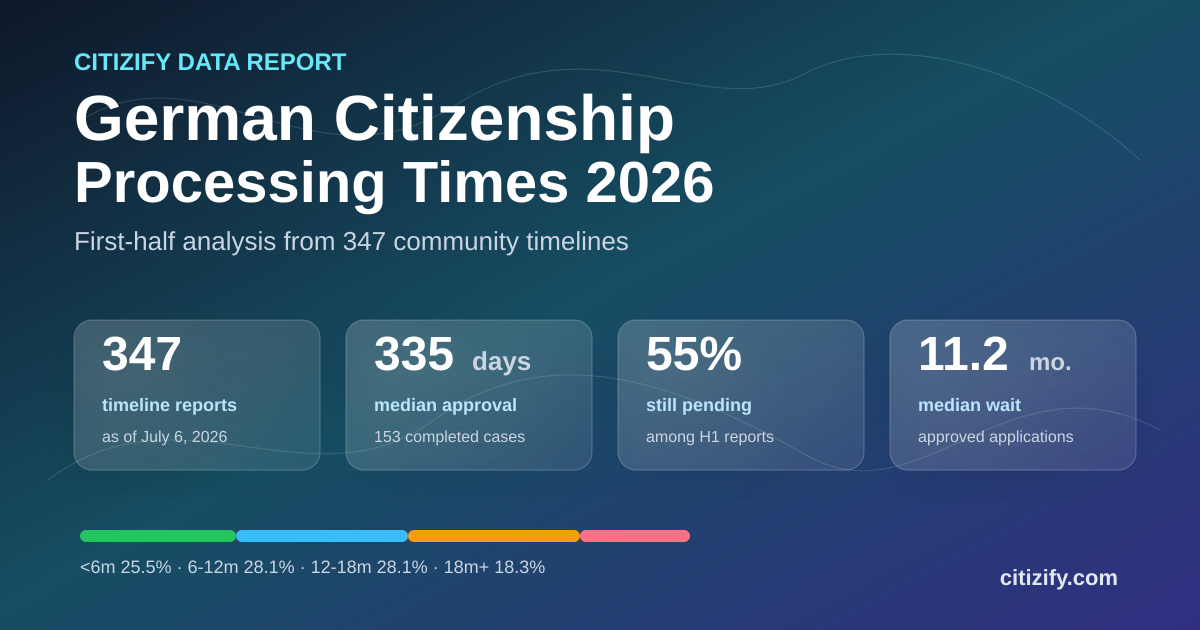
- The median approved case took 335 days; the average was 376 days.
- The middle 50% of approved cases finished between 179 and 460 days.
- 18.3% of approved cases took more than 18 months; 7.8% took more than two years.
- Pending cases are already old: among 187 pending timelines with a submission date, the median pending age was 307 days.
- Berlin looks faster than many people expect in this sample: 35 approved Berlin cases had a median of 249 days.
- Higher German level did not clearly correlate with faster processing. B1 cases had a median of 314 days; C1 cases had 345 days. That does not mean language is irrelevant for eligibility, only that authority processing speed appears to depend more on the office and file handling.
Why 2026 is different
Official demand is rising. Destatis reports 332,524 naturalisations in 2025, up from 292,020 in 2024 and 200,095 in 2023. That is the national backdrop behind the long waits many applicants report. Source: Destatis naturalisation statistics.
The legal eligibility threshold is not the same as processing speed. The German government’s official Make it in Germany portal lists the main standard requirements: more than five years of legal residence, a qualifying residence status, financial self-support, German at minimum B1, knowledge of the legal and social system, no criminal conviction, and the constitutional commitment. It also lists the current naturalisation fee as €255 per adult and €51 per minor child. Source: Make it in Germany: Naturalisation.
Dataset: what exactly did we analyse?
We used the Citizify citizenship timeline database as it stood on July 6, 2026. The dataset contained 347 reports. Of those, 340 were submitted to Citizify between February and June 2026. We had no January collection month because the current timeline dataset starts on February 4, 2026.
| Lens | Rows | What it is good for | Main caveat |
|---|---|---|---|
| All timeline reports | 347 | Overall community picture | Not a representative government sample |
| H1 2026 reports | 340 | What Citizify users reported in the first half of 2026 | Includes cases submitted in earlier years |
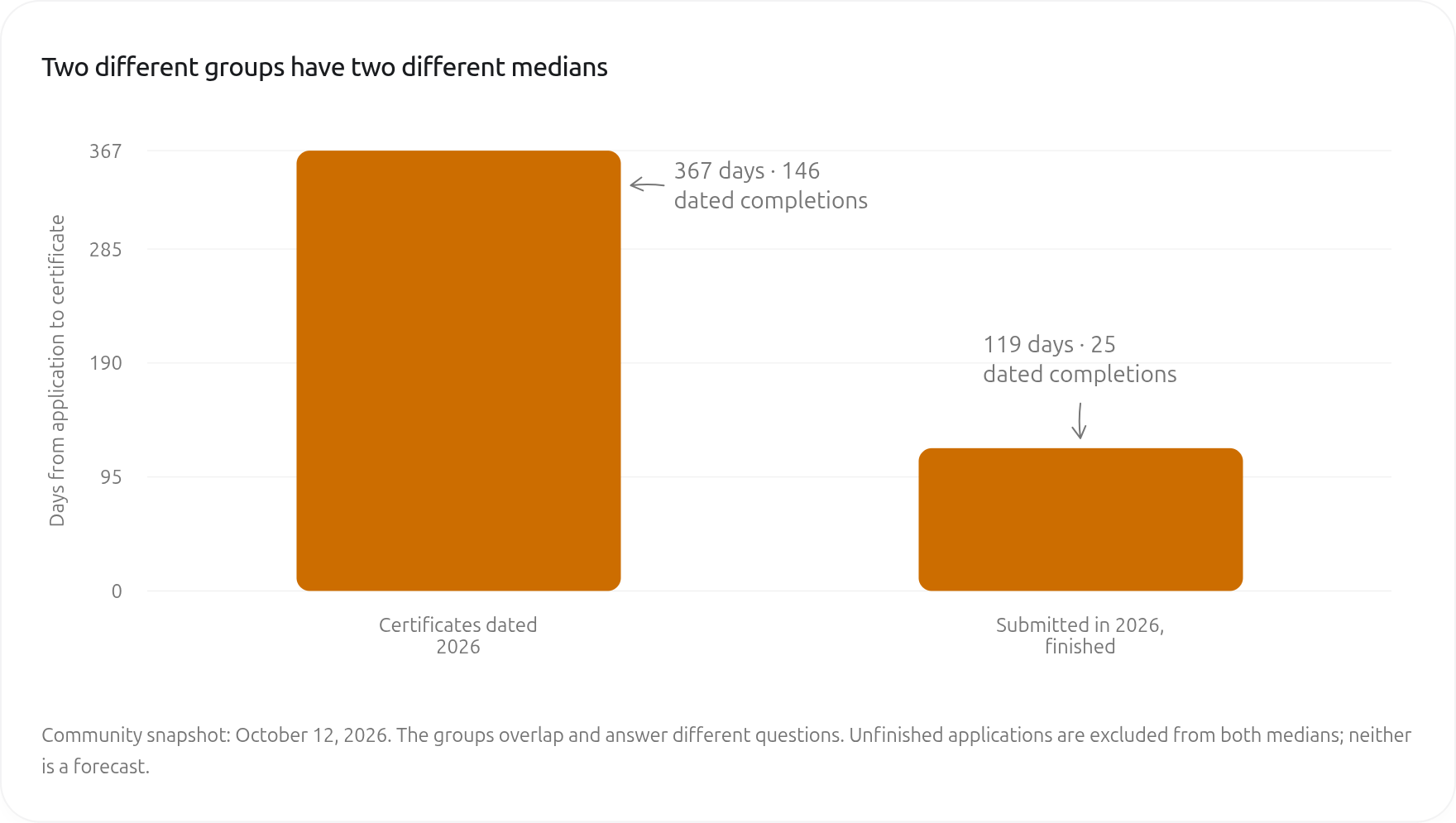
| H1 2026 application cohort | 59 | What happened to applications submitted Jan-Jun 2026 | 83.1% are still pending |
| Approved benchmark | 153 | Processing time statistics | Completed cases over-represent people who already got an outcome |
Processing time distribution: the “average” hides a wide spread
The headline number is simple: approved timelines took a median of 335 days. But the spread matters more than the average. A quarter of approved cases finished within 179 days, while a quarter took longer than 460 days. The 90th percentile was 669 days.
Approved cases by processing time
In practical terms: a one-year wait is not unusual. In this dataset, 46.4% of approved cases took at least 12 months, and 18.3% took 18 months or longer.
The pending backlog: many people are not “late” yet, but they are already waiting
Pending cases are the part applicants feel most strongly. Among 187 pending timelines with a known submission date, the median pending age was 307 days. The 75th percentile was 518 days, and the 90th percentile was 730 days.
Pending cases by current waiting age
H1 2026 applications: most are still unresolved
We found 59 timeline reports where the application was submitted between January and June 2026. Only 10 were already approved by July 6. The other 49 were still pending. That means any “2026 applications are approved in X days” claim is likely misleading at this point.
Applications submitted in H1 2026
State-level pattern: Berlin is not the slowest in this dataset
City and state rankings are noisy because applications are not distributed evenly. Still, the pattern is useful: processing speed varies far more by local authority than by nationality or language level.
| State | Approved cases | Average | Median |
|---|---|---|---|
| Berlin | 35 | 266 days | 249 days |
| Niedersachsen | 8 | 297 days | 267 days |
| Nordrhein-Westfalen | 36 | 319 days | 296 days |
| Baden-Württemberg | 13 | 341 days | 363 days |
| Hessen | 9 | 357 days | 335 days |
| Bayern | 30 | 416 days | 381 days |
| Hamburg | 5 | 570 days | 453 days |
| Sachsen | 6 | 1192 days | 1270 days |
Berlin had the largest state sample in the approved benchmark and a median of 249 days. Saxony looked much slower, but the sample is only six approved cases and strongly influenced by Leipzig reports older than three years.
City ranking: useful, but sample size matters
The following table only includes cities with at least three approved cases in our dataset. We show the city links so you can inspect the underlying timeline page and future updates.
| City | State | Approved cases | Average | Median |
|---|---|---|---|---|
| Berlin | Berlin | 35 | 266 days | 249 days |
| München | Bavaria | 14 | 582 days | 597 days |
| Aachen | NRW | 11 | 366 days | 396 days |
| Ingolstadt | Bavaria | 7 | 114 days | 117 days |
| Stuttgart | BW | 6 | 352 days | 335 days |
| Köln | NRW | 5 | 433 days | 464 days |
| Hamburg | Hamburg | 5 | 570 days | 453 days |
| Leipzig | Saxony | 5 | 1298 days | 1292 days |
| Bonn | NRW | 4 | 130 days | 135 days |
| Düsseldorf | NRW | 4 | 196 days | 173 days |
| Hannover | Lower Saxony | 4 | 244 days | 175 days |
| Darmstadt | Hesse | 3 | 471 days | 573 days |
Where did people apply in the first half of 2026?
H1 2026 submissions were heavily concentrated in Berlin. In our H1 application cohort, 24 of 59 reports were from Berlin. That is 40.7% of the H1-submitted cohort.
Top H1 2026 application cities
Does German level make the process faster?
In the law, German level matters for eligibility. For standard naturalisation, B1 is the main benchmark listed by official guidance. In our processing-time data, however, higher language level did not clearly translate into faster authority processing.
| Language level | Approved cases | Average | Median |
|---|---|---|---|
| B1 | 88 | 365 days | 314 days |
| C1 | 27 | 410 days | 345 days |
| B2 | 13 | 388 days | 352 days |
| C2 | 11 | 427 days | 476 days |
| Unknown | 14 | 329 days | 335 days |
This is not proof that language never matters. It means that once an application is accepted into the process, the bottleneck in this dataset appears to be local administration, file completeness, appointments, document requests, and workload rather than whether someone reported B1, B2, C1, or C2.
Route comparison: standard route dominates the dataset
Most reports were standard five-year-route cases. Marriage-route and special-route samples are much smaller, so we avoid strong conclusions there.
| Route | Approved cases | Average | Median |
|---|---|---|---|
| Standard 5-year route | 142 | 379 days | 345 days |
| Marriage 3-year route | 6 | 315 days | 160 days |
| Special route | 5 | 375 days | 345 days |
First response: many applicants wait weeks before anything happens
For 143 reports with a first-response value, the median time to first response was 45 days. But the average was 143 days, which means the long tail is severe. The 90th percentile was 361 days.
That gap between median and average is important: many applicants hear something within a few weeks, but a meaningful minority waits nearly a year just for the first visible movement.
What applicants should take from this
- Do not benchmark yourself against the fastest cases. Fast approvals exist, but they are not the normal expectation.
- Use city-level data, not national averages. A Berlin case and a Munich case can look very different even under the same federal law.
- Track your submission date and every response. If a file becomes stuck, dated records matter.
- Expect local variation. The law is federal, but the processing experience is local.
- Share your timeline. The dataset becomes more useful only when more applicants contribute anonymized reports.
Check your city or add your timeline
Citizify’s timeline tracker lets applicants compare processing times by city and share anonymized updates. More reports make the city pages more reliable for everyone.
Sources and limitations
- Citizify data: 347 anonymized, self-reported citizenship timelines extracted on July 6, 2026.
- Official naturalisation totals: Destatis, Naturalisations 2000 to 2025.
- Official naturalisation requirements and fees: Make it in Germany, Naturalisation.
- Naturalisation test context: BAMF, Naturalisation in Germany.
- This article is not legal advice. For binding guidance, contact your local naturalisation authority or a qualified immigration lawyer.
Did you find this report helpful?
Citizify is an independent, reader-supported project. A report like this takes many hours of data work, and we keep the city timelines free for everyone. If it helped you, a small contribution lets us keep the research and the data going.
❓ German citizenship processing time data FAQ
Is this official German government data?+
Why do you separate 2026 applications from completed applications?+
What is the median German citizenship processing time in this dataset?+
Which city looks fastest in the data?+
Can I add my own timeline?+
Did this guide help you?
☕ Support Citizify
We create free resources for language learners. Your small contribution helps us keep going.
Thank you for your support! 💙